
Dropshipping in Lithuania: what it is, what it costs to start and whether it is worth it
On this page · 9
Dropshipping is online selling without a warehouse: the buyer orders in your online shop and the supplier ships the product straight to them. You can start without stock, but you need a budget for advertising and a platform, and from July 2026 parcels from non-EU countries carry an additional 3 € customs duty per type of goods.
Dropshipping is an online selling model in which you sell products you do not keep in a warehouse: the buyer orders in your online shop, you pass the order on to the supplier, and the supplier ships the product straight to the buyer. In Lithuania “dropshipping” and “dropshippingas” are searched for about a thousand times a month, yet almost all the information is in English and written for the US market.
This guide is about dropshipping in Lithuania: how the model works, what it costs to start, where to find suppliers, which taxes and customs duties apply from 2026, and when it makes sense to choose a different way of selling online.
In short
- Dropshipping lets you start selling without a warehouse or a large investment in stock, but the margin is lower and competition is heavy.
- The biggest costs are not the products but the advertising needed to attract buyers and the online shop platform.
- From 1 July 2026, parcels from non-EU countries worth up to 150 € are subject to a 3 € customs duty for each type of goods, which makes European suppliers more attractive.
- Selling is an activity that has to be formalised, and you need to know the VAT rules in advance.
Read in order or pick a topic
- 01
 Next chapterDropshipping suppliers: how to choose a European or a Chinese supplierDropshipping suppliers for sellers in Lithuania: European warehouses and Chinese platforms, delivery time, the 3 € customs duty from 2026 and what to check before starting.4 min read
 - 02
 Dropshipping and taxes in Lithuania: form of activity, VAT, IOSS and customs dutiesDropshipping taxes in Lithuania: which form of activity to choose, when you become a VAT payer, how OSS and IOSS work, the 3 € customs duty on parcels from non-EU countries.4 min read
 - 03
 Print on demand: how to sell products with your own designs without a warehousePrint on demand in Lithuania: how printing to order works, which products you can sell, how to choose a manufacturer in Europe and how much really remains from one sale.3 min read
 - 04
 Creating an online shop: platforms, cost and where to startCreating an online shop: which platform to choose, how much an online shop costs, whether it can be built for free and which documents are mandatory in Lithuania.3 min read
 - 05
 Selling online: where to start and where to sellHow to start selling online: where to sell – on marketplaces, on social networks or in your own online shop, what you can sell without registering an activity and when self-employment is required.4 min read
How dropshipping works
You are the intermediary who looks after the shop, the advertising and the buyers. The supplier looks after the products, the warehouse and shipping. Your income is the difference between the price the buyer pays and what you pay the supplier for the product and shipping.
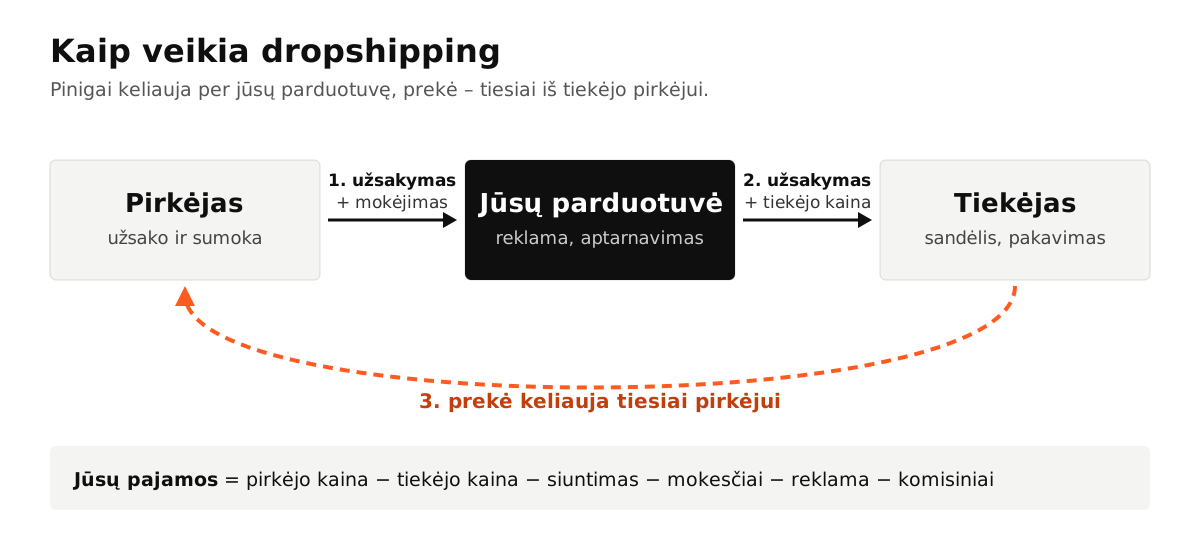
- The buyer orders and pays in your online shop.
- The order is passed to the supplier automatically or manually, and you pay the supplier’s price.
- The supplier packs the product and ships it to the buyer.
- You are responsible for customer service, returns and complaints – to the buyer, the seller is you.
Advantages and disadvantages
| Advantages | Disadvantages |
|---|---|
| No need to buy products in advance or keep a warehouse | Lower margin than when buying at wholesale prices |
| You can try many products without the risk of being left with unsold stock | You do not control product quality or shipping speed |
| You can work from anywhere | You answer to the buyer for the supplier’s mistakes |
| Easy to start | Heavy competition – many others sell the same products |
What it costs to start
Dropshipping is often advertised as a business “with no investment”, but that is not true. You do not need to buy products in advance, yet there are costs:
- Online shop platform – a monthly fee or a one-off build cost.
- Domain – a small annual fee.
- Advertising – the biggest cost and the hardest to predict. Without advertising or an audience of your own, buyers do not appear.
- Product samples – worth ordering for yourself so you can check the quality and take photographs.
- Payment system fees – on every sale.
Realistically, plan a budget for several months of advertising tests and be prepared for some of them not to pay off.
Where to find suppliers
Suppliers fall into two groups: European warehouses, from which products reach buyers within a few days, and Chinese suppliers, whose products are cheaper but travel longer and from 2026 are subject to an additional customs duty. How to choose a supplier and what to check is covered in the part of the guide on dropshipping suppliers.
Taxes, VAT and customs duties
Dropshipping is trade, so the activity has to be formalised: as self-employment (individuali veikla) or through a company. The main things to know in advance:
- from 1 July 2026, parcels from non-EU countries with a value of up to 150 € are subject to a 3 € customs duty for each type of goods, with VAT added on top;
- VAT on such parcels can be paid at the time of sale through the Import One-Stop Shop (IOSS);
- when selling to buyers in other EU countries, the VAT rules for distance selling apply.
More detail is in the part of the guide on dropshipping taxes. Which form of activity suits you is explained in the ACS.lt article “Self-employment: registration certificate or business certificate”.
Is dropshipping worth it in Lithuania
Dropshipping can work if you find a niche where products are hard to find in local shops and you know how to attract buyers for less than you earn from one sale. It does not work if you sell the same products as hundreds of others and expect advertising to pay for itself.
Answer these before you start
- Why would a buyer buy from you rather than from a large marketplace?
- How much do you earn from one sale after deducting the product, shipping, taxes and fees?
- How much does it cost to attract one buyer?
Alternatives without a warehouse
If dropshipping looks too risky, there are other ways to try selling without a warehouse:
- Print on demand – you sell T-shirts, mugs or posters with your own designs, which are produced only once ordered.
- Affiliate marketing – you recommend other people’s products and receive a commission. You need neither a shop nor customer service.
- Selling your own things or handmade goods – smaller volume, but a higher margin and no suppliers.
Frequently asked questions
What is dropshipping in simple terms?
It is online selling where you sell products you do not hold: the buyer orders in your shop and the supplier ships the product straight to them.
Is dropshipping legal in Lithuania?
Yes. It is ordinary trade that has to be formalised as self-employment or through a company, and it must comply with VAT and consumer rights requirements.
How much does it cost to start dropshipping?
You do not need to buy products in advance, but you do have to pay for the online shop platform, a domain, product samples and, above all, advertising.
What customs duty applies to goods from China?
From 1 July 2026, parcels from non-EU countries with a value of up to 150 € are subject to a 3 € customs duty for each type of goods, with VAT added on top.
Who answers to the buyer if the product is damaged?
The seller – that is, you. It makes no difference to the buyer that the supplier shipped the product, so it is worth agreeing the terms for returns and complaints with the supplier in advance.
Sources
- Muitinės departamentas. Nuo 2026 m. liepos 1 d. mažos vertės siuntoms iš ne Europos šalių bus taikomas muitas
https://muitine.lrv.lt/lt/naujienos/nuo-2026-m-liepos-1-d-mazos-vertes-siuntoms-is-ne-es-saliu-bus-taikomas-muitas-qx4/ - Lietuvos paštas. Nuo liepos 1 d. – 3 eurų muitas mažos vertės siuntoms iš ne ES šalių
https://www.post.lt/lt/apie-mus/naujienos/nuo-liepos-1-d-3-euru-muitas-mazos-vertes-siuntoms-ne-es-saliu - Europos Komisija. PVM deklaravimo vieno langelio principu sistemos gairės
https://vat-one-stop-shop.ec.europa.eu/system/files/2021-07/OSS_guidelines_lt.pdf