
Freelancing in Lithuania: how to start freelance work and where to find orders
On this page · 10
- What freelancing is and how it differs from employment
- What services you can provide
- Where to find orders: three routes
- How to start: five steps
- How much to charge for the work
- Form of activity and taxes
- Risks worth knowing about in advance
- Additional income alongside orders
- Frequently asked questions
- Sources

Freelancing means providing services to several clients without an employment contract: you look for clients yourself, set the price and pay the taxes. Orders can be found on the platforms Fiverr (20% commission) and Upwork (0–15%) or by working with clients directly. In Lithuania the activity is most often made official as self-employment under a certificate (individuali veikla pagal pažymą).
Freelancing (in Lithuanian, laisvai samdomas darbas) is work without an employment contract: you provide services to several clients, set your own price, find clients yourself and pay your own taxes. In Lithuania the words “freelance” and “freelancer” are searched for about two thousand times a month, and the international platforms Fiverr and Upwork several times more often.
This guide is for those who want to start freelancing from Lithuania: where to find your first orders, how much the platforms take, how to set a rate, what to put in a contract and how to make the activity official. Platform commissions and rules were checked in the platforms' own terms in October 2026.
In short
- Legally, a freelancer is a self-employed person: the Labour Code, holidays and sick pay from an employer do not apply, and the freelancer pays the taxes.
- Fiverr takes 20% of every order from the seller, Upwork takes from 0 to 15%, depending on the contract. When you work with a client directly there is no commission, but there is no payment protection either.
- In Lithuania the activity is most often best made official as self-employment under a certificate (individuali veikla pagal pažymą). A business certificate (verslo liudijimas) is almost unsuitable for work with companies.
- When you work with foreign companies or through foreign platforms, VAT obligations can arise even before you reach the 45 000 € threshold.
Read in order or pick a topic
- 01
 Next chapterFiverr: how it works, how much it takes and how to start selling services from LithuaniaHow Fiverr works for a seller from Lithuania: creating a service (Gig) step by step, the 20% commission, buyer fees, payouts via PayPal and Payoneer, seller levels.6 min read
 - 02
 Upwork: how it works, how much Connects cost and how to get your first orderHow Upwork works for a freelancer from Lithuania: Connects, the 0–15% service fee, hourly and fixed-price contracts, payment protection and payouts to a bank.6 min read
 - 03
 Writing texts and copywriting: how to start, how much to charge and where to find ordersWriting texts as a freelancer: what texts are ordered, how a copywriter differs from a content writer, how the price per character and per text is calculated, the portfolio and the impact of artificial intelligence.7 min read
 - 04
 Working as a freelance translator: qualifications, orders and ratesRemote translation work: whether you need a licence in Lithuania, what a notary actually certifies, what kinds of translation work there are, how pay per page, per word and per author's sheet is calculated, where to look for orders.7 min read
 - 05
 Working as a freelance graphic designer: portfolio, orders and copyrightHow to work as a freelance graphic designer: the portfolio, where to look for orders, pricing and how to transfer the rights to a logo or layout in a contract under the Law on Copyright.7 min read
 - 06
 Freelance contracts and prices: how to set a rate, get an advance payment and invoice a foreign clientHow a freelancer can calculate an hourly rate, what to put in a contract, how to protect yourself against forged bank details, which form of activity to choose and when a VAT obligation arises when working with foreign clients.10 min read
What freelancing is and how it differs from employment
A freelancer is not an employee in the legal sense. The link with the client is not an employment contract but a service or copyright contract: the parties agree on the result, the deadline and the price, while how, where and when the work is done is decided by the freelancer.
| Employment contract | Freelancing | |
|---|---|---|
| Income | An agreed salary every month | As much as the orders completed and paid for |
| Taxes | Calculated and paid by the employer | You declare and pay them yourself |
| Holidays, illness | Paid under the Labour Code | Time without orders is time without income |
| Work tools | Provided by the employer | Computer, software, training – your expenses |
| Finding clients | Not your concern | A permanent part of the job |
| Freedom | Working hours and place are agreed | You choose the orders, the time and the price yourself |
The table shows why a freelancer's hourly rate has to be higher than an employee's hourly pay: it has to cover taxes, holidays, sick days, equipment and the hours you spend looking for clients.
What services you can provide
Freelancing works where the result can be delivered online and clearly described in advance. The most common fields:
- Texts: articles, advertising copy, SEO texts, editing, proofreading.
- Translation: translation of documents, websites, software, literature.
- Design: logos, brand identity, social media visuals, publication layouts, interface design.
- Programming and websites: website development, online shops, automation.
- Marketing: managing advertising campaigns, social media administration, SEO.
- Video and audio content: editing, voice-over, subtitles.
- Administration: virtual assistant services, data handling, customer service.
The three fields searched for most often in Lithuania – copywriting, translation and graphic design – have separate parts of the guide devoted to them.
Where to find orders: three routes
There are three ways to reach a client, and each has its price. Platforms have many clients, but you hand part of your earnings to the intermediary. Working directly you keep everything, but you look for clients and bear the payment risk yourself.
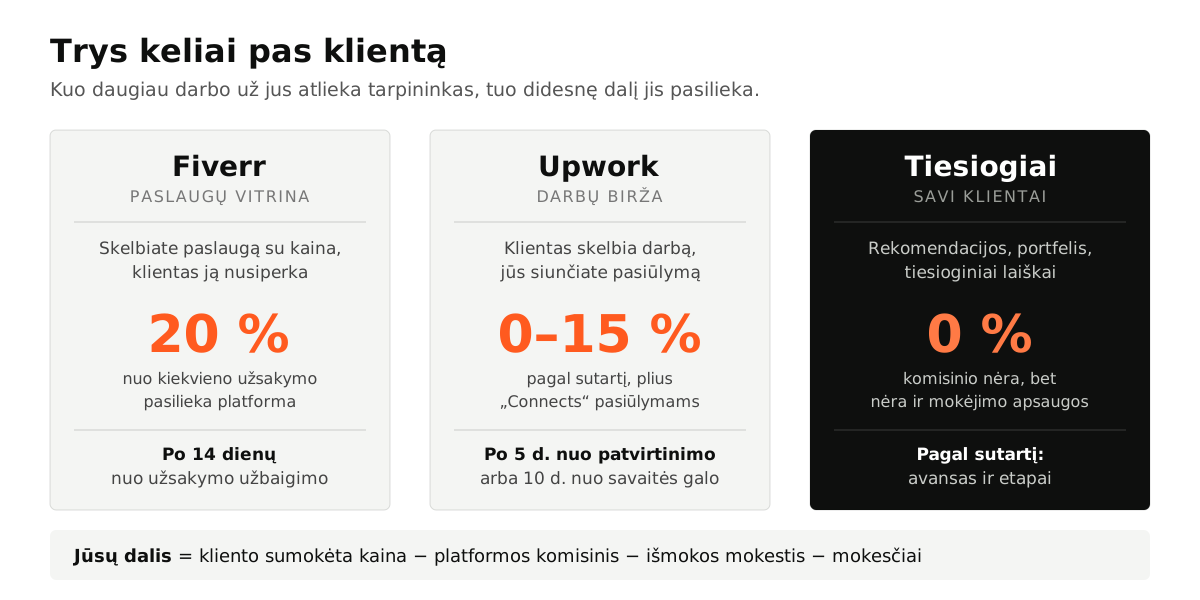
| Fiverr | Upwork | Direct clients | |
|---|---|---|---|
| How an order is obtained | You list a service with a price, the client buys it | The client posts a job, you send a proposal | Recommendations, portfolio, social networks, direct emails |
| Fee for the freelancer | 20% of the order amount | 0–15% depending on the contract; in addition, you pay for Connects to send proposals | None |
| Payment protection | The client pays the platform in advance | Funds are held in escrow or hourly protection applies | Only what you provide for in the contract (advance payment, milestones) |
| When the money is yours | 14 days after the order is completed | 5 days after the milestone is approved or 10 days after the end of the week | According to the agreed deadline |
Beginners usually combine several routes: a platform provides the first orders and reviews, and over time a larger share of income comes from regular clients you work with directly.
How to start: five steps
- Choose one service. “I write texts for online shops” is easier to sell than “I write everything”. A narrow specialisation lets you prepare samples and state a clear price.
- Prepare 3–5 work samples. If you have not had any orders yet, create the samples yourself: a text for an invented product, a logo for an invented café. What matters is that it is clear this is a sample, not work for a real client.
- Calculate your rate. The starting point is not “how much others charge” but how much you need to earn per month and how many hours you can realistically sell.
- Create a profile on one platform and at the same time tell the people around you about the service – the first orders often come from people you know.
- Make the activity official before you issue your first invoice. Self-employment under a certificate is registered through VMI's “Mano VMI” system.
How much to charge for the work
The price can be hourly, per unit (word, page, logo) or for the whole project. Which one to choose depends on whether the scope of work can be precisely defined in advance. When you calculate your minimum hourly rate, it has to include:
- taxes and social insurance contributions;
- the platform commission and payout fees;
- unpaid hours: proposals, correspondence, invoices, learning;
- holidays and sick days that nobody will pay for;
- equipment and software subscriptions.
How to turn these components into a specific number and what to put in a contract is explained in the part of the guide on contracts and prices.
Form of activity and taxes
Services provided regularly are an economic activity that has to be made official. The comparison by the State Tax Inspectorate (VMI) states:
- self-employment under a certificate allows any activity not prohibited by law, it is registered for an unlimited period and can be started from the day the application is submitted;
- a business certificate is issued only for a limited list of activities, and income received from companies is attributed to it only up to 4 500 € per year – so it is almost unsuitable for work with business clients;
- a small partnership (MB) or a private limited company (UAB) is worth considering when volumes are larger, you work with a team or you want to separate business and personal assets.
Which form suits you is explained in the ACS.lt article “Self-employment: registration certificate or business certificate”, and you can work out your income tax with the personal income tax (GPM) calculator.
VAT – not only from 45 000 €
VMI states that registering as a VAT payer is mandatory not only once you exceed the 45 000 € threshold, but also when you provide services to companies in other EU countries or purchase services from foreign companies. In that case you can apply the small business scheme and not charge VAT on sales in Lithuania. Consult an accountant before your first invoice to a foreign client.
Risks worth knowing about in advance
- A client who does not pay. When you work directly, only a contract, an advance payment and payment in stages protect you.
- Uneven income. One month there are too many orders, the next – none. In the first year it is worth having a reserve for several months.
- One big client. If it accounts for most of your income, losing it means losing almost all of your income.
- Work outside the platform. If a client found on a platform offers to pay “directly, without the commission”, you lose payment protection and put your account at risk.
- Forged bank details. Scammers break into an email exchange and send a “new account number”.
The last risk is not theoretical. A police incident report from October 2026 describes a case: a company in Trakai district received by email forged account details of its foreign partners and transferred 54 374 € to the specified account at a foreign bank. For a freelancer this matters from both sides: your client can receive a fake email “in your name”, and you can receive a fake invoice from a subcontractor.
The rule is simple: always verify a changed account number through another channel – call a number you already know. If the money has already been transferred, call your bank immediately and report it to the police via epolicija.lt or by phone on 112.
Additional income alongside orders
A freelancer's income depends directly on the hours sold. Some try to balance this with income that does not depend on hours: they recommend tools and products they use themselves and receive a commission. This does not replace orders, but it can cover part of the quieter months.
Frequently asked questions
What is freelancing?
Freelancing means providing services to clients without an employment contract. The freelancer looks for clients, agrees on the price and deadline, pays the taxes and is not bound by the Labour Code.
How do you make freelance work official in Lithuania?
Most often as self-employment under a certificate (individuali veikla pagal pažymą), which can be registered through the “Mano VMI” system of the State Tax Inspectorate (VMI). A business certificate (verslo liudijimas) is almost unsuitable for work with companies, because income received from companies is attributed to it only up to 4 500 € per year.
How much do Fiverr and Upwork take?
Fiverr leaves the seller 80% of the order amount, i.e. it takes 20%. Upwork applies a variable fee of 0–15%, which is shown before you send a proposal and does not change during the contract.
Does a freelancer have to register as a VAT payer?
It is mandatory once you exceed 45 000 € per year, and also when you provide services to companies in other EU countries or purchase services from foreign companies. In the latter cases you can apply the small business scheme and not charge VAT on sales in Lithuania.
Where do I start if I do not have a single client?
Choose one clear service, prepare 3–5 work samples, calculate your rate, create a profile on one platform and tell the people around you about the service. The first orders often come from people you know.
Sources
- Fiverr. Payment Terms
https://www.fiverr.com/legal-portal/legal-terms/payment-terms-of-service - Upwork. Learn about the Freelancer Service Fee
https://support.upwork.com/hc/en-us/articles/211062538-Learn-about-the-Freelancer-Service-Fee - Upwork. How to get paid on Upwork
https://support.upwork.com/hc/en-us/articles/211060918-How-to-get-paid-on-Upwork - Valstybinė mokesčių inspekcija. Individualios veiklos pagal pažymą ir verslo liudijimo palyginimas
https://www.vmi.lt/evmi/kuri-veiklos-forma-man-tinkamesne - Valstybinė mokesčių inspekcija. Kada atsiranda prievolė registruotis PVM mokėtoju?
https://www.vmi.lt/evmi/kada-atsiranda-prievole-registruotis-pvm-moketoju- - Lietuvos policija. Paros įvykių suvestinės
https://policija.lrv.lt/lt/ivykiu-suvestines/