
Digital products: what to create, where to sell and how much the seller keeps
On this page · 10

A digital product is a file or access that you create once and sell many times: an e-book, a template, an online course or a photo. You can sell on your own website or on platforms that take part of the price: Etsy takes 6.5% and a payment fee, Amazon KDP leaves the author 35% or 70%, stock photo agencies – 15–40%.
A digital product is a file or access that you create once and sell many times: an e-book, a template, an online course, a photo. You need no warehouse, packing or shipping, the buyer receives the product immediately, and the thousandth sale costs the same as the first.
That does not mean the money comes by itself. The product has to be created, it needs buyers, and the platforms that have those buyers take part of the price. This guide is about which digital product is worth creating, where to sell it from Lithuania, how much the seller keeps and which rules – on taxes, consumer rights, licences – you need to know in advance.
In short
- The easiest way to start is with what you already know how to do: turn knowledge into a book or a course, design skills into templates, photography into a photo portfolio.
- Platforms take from a few per cent to 85% of the price: Etsy takes 6.5% and a payment fee, Amazon KDP leaves the author 35% or 70%, stock photo agencies – 15–40%.
- A buyer of digital content has a 14-day right of withdrawal, unless they expressly agree to lose it before downloading.
- From 2026 a 5% VAT rate applies to e-books in Lithuania.
Read in order or pick a topic
- 01
 Next chapterE-book: how to write, publish and sell oneHow to publish an e-book: EPUB or PDF, the ISBN in Lithuania and its price, Amazon KDP royalties and why this platform is not suitable for a book in Lithuanian, the 5% VAT rate for e-books.7 min read
 - 02
 Selling on Etsy from Lithuania: shop, fees and digital filesHow to sell on Etsy from Lithuania: opening a shop, all the fees (0.20 USD, 6.5%, 4% + 0.30 €), limits for digital files and how Etsy collects VAT.6 min read
 - 03
 Canva templates: how to create and sell them without breaching the licenceWhat the Canva licence allows when selling templates: original design, Pro content only via a template link, how to deliver a template to the buyer and where to sell it.6 min read
 - 04
 Online courses: how to create one, where to host it and how to sell itHow to create an online course: formats, the steps from idea to recording, platform commissions, pricing and when the buyer has the right to withdraw from the course within 14 days.6 min read
 - 05
 Selling photos online: stock agencies, licences and releasesWhere and how to sell photos online: how much Adobe Stock, Shutterstock and iStock pay the author, types of licences, model releases and where AI-generated images are accepted.6 min read
What kinds of digital products there are
| Product | What needs to be created | Where it is most often sold | Who it suits |
|---|---|---|---|
| E-book | Manuscript, editing, cover, EPUB or PDF file | Your own website, e-book shops, Amazon KDP (not in Lithuanian) | Those with knowledge that can be set out in writing |
| Templates and printable files | Design, instructions for the buyer, mockups | Etsy, your own shop | Designers and anyone who is good with Canva or similar tools |
| Online course | Syllabus, lesson recordings, assignments | Your own website, course platforms | Experts and lecturers who have or are building an audience |
| Photos and videos | Portfolio, keywords, releases | Stock photo agencies, direct licences | Photographers who shoot regularly |
How much the seller keeps
A digital product has no cost per unit, but it does have a cost of sale: the platform fee, or advertising and time costs if you bring in the buyers yourself. The diagram shows the rules of the main platforms, checked on their own pages.
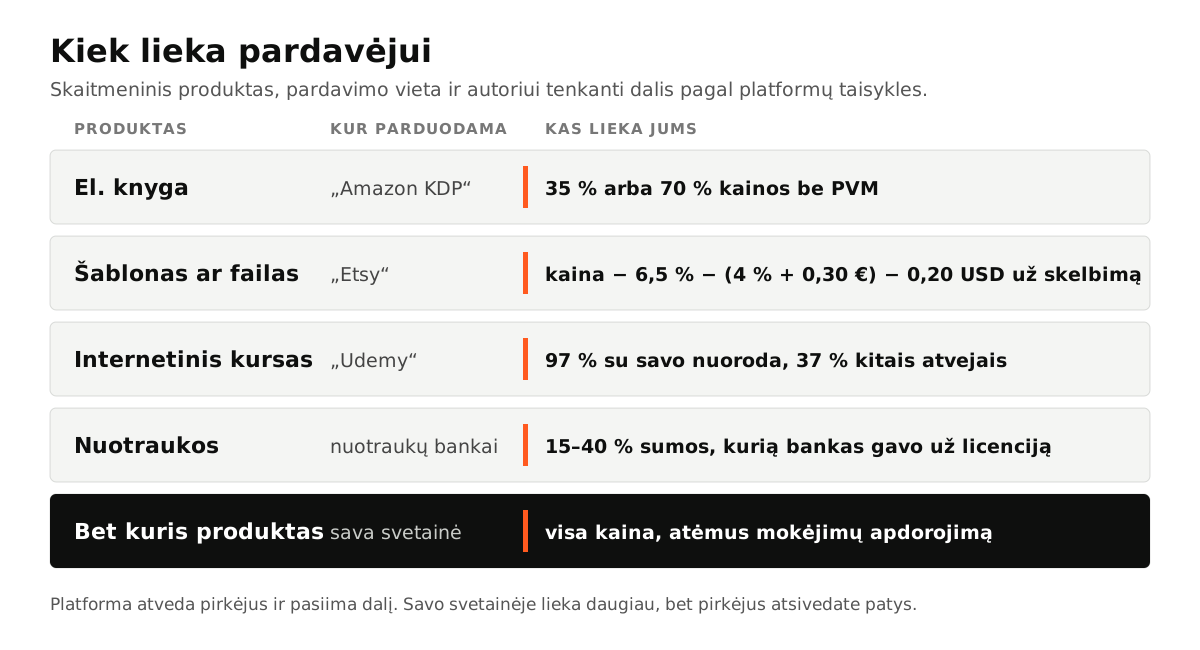
The figures are not directly comparable. 37% from a buyer the platform brought can be more money than 100% from a buyer you would never have found. So the question is not “where is the fee lower” but “who will bring the buyers”.
Platform or your own website
| Platform or marketplace | Your own website | |
|---|---|---|
| Buyers | Already there and searching | You have to bring them: content, social networks, advertising, affiliates |
| Fees | On every sale | Only payment processing and tools |
| Price | Determined by competition, sometimes by the platform itself | You set it yourself |
| Buyers' contact details | Usually stay with the platform | Yours |
| VAT for buyers abroad | The platform takes over part of the obligations (for example, Etsy for digital files) | Your responsibility |
| Risk | Rules and fees can change, the account can be suspended | You depend only on yourself |
A common route is to start on a platform, where it is easier to get the first sales and reviews, and later invite regular buyers to your own website. Just remember that some platforms, Etsy among them, prohibit moving transactions off the platform.
How to choose what to create
Four questions before you start
- What do people already ask me? Recurring questions are a ready-made product topic.
- Who would pay for it? A specific person with a specific problem, not “everyone”.
- What do they buy now? If there are no similar products at all, there may be no demand either.
- How will they find out about me? If there is no answer, start with a platform where buyers search by themselves.
Start small: one set of templates, a short guide, a series of ten photos. A small product shows more quickly whether the topic sells and teaches you the whole process – from creation to payment.
Taxes in Lithuania
Regular sales of digital products are an activity that has to be made official and on which taxes are paid, regardless of whether the money comes from Lithuania or from a foreign platform.
- Form of activity. Most often – self-employment under a certificate (individuali veikla pagal pažymą). Which form suits you is explained in the ACS.lt article “Self-employment: registration certificate or business certificate”.
- VAT registration. Mandatory when income in Lithuania exceeds 45 000 € per year.
- Sales to residents of other EU countries. Digital products are treated as electronic services. As long as the value of such sales (together with distance sales of goods) does not exceed 10 000 € per year, they are taxed in Lithuania. Above the threshold VAT is paid at the rate of the buyer's country – the OSS system is intended for this.
- E-books. From 1 January 2026 the reduced 5% VAT rate applies to them.
- Platform data. Platforms, when required by law, pass sellers' and transaction data to the tax authorities.
Consumer rights: withdrawal within 14 days
When you sell to consumers online, the Civil Code rules on distance contracts apply: the buyer has the right to withdraw from the contract within 14 days. There is an exception for digital content, but it works only when the buyer has expressly agreed in advance that the content be supplied immediately, has acknowledged that they lose the right of withdrawal, and has received confirmation of the contract.
Marketplaces have their own download and refund procedures. When you sell on your own website, you have to implement the consent checkbox and the confirmation email yourself. More detail is in the part of the guide on online courses.
Copyright and artificial intelligence
- Sell only what you created or what you hold a licence for. Fonts, photos, illustrations, music – everything in the product has to be permitted for commercial use.
- A tool's licence is not copyright. Canva allows you to create designs for sale from the elements in its library, but prohibits selling those elements separately.
- Platforms treat AI content differently. Etsy requires AI use to be stated in the listing description. Adobe Stock accepts labelled AI images, Shutterstock and Getty Images do not.
- Ownership of AI works is legally unclear. Canva itself warns that in many countries you may not be the copyright holder of a generated image.
Where to start
- Choose one type of product and one audience.
- Create the smallest sellable version within a few weeks, not months.
- Choose one place to sell and read its fee and content rules.
- Make the activity official before the first sale.
- Sell to the first ten buyers and ask what was missing.
- Only then expand: more products, a second platform, your own website.
If you do not have your own product yet, you can also earn from digital products without creating them – by recommending other authors' products for a commission.
Frequently asked questions
What is a digital product?
A file or access that you create once and sell many times without a warehouse or shipping: an e-book, a template, an online course, a photo, an audio recording.
Where can you sell digital products from Lithuania?
On your own website or on platforms: templates and files on Etsy, courses on course platforms, photos at stock photo agencies, books in English on Amazon KDP. Etsy Payments works in Lithuania.
How much do platforms take from a sale?
Etsy – a 6.5% transaction fee, 4% + 0.30 € for payment processing and 0.20 USD per listing. Amazon KDP leaves the author 35% or 70%, Udemy – 97% or 37%, stock photo agencies – 15–40%.
Can a buyer return a digital product?
A consumer has a 14-day right of withdrawal. It does not apply if, before receiving the content, the buyer expressly agreed that it be supplied immediately, acknowledged that they lose this right and received confirmation of the contract.
What taxes apply when selling digital products?
Income is taxed as income from activity. Registering as a VAT payer is mandatory once you exceed 45 000 € per year; a separate 10 000 € threshold applies to sales to residents of other EU countries. From 2026 a 5% VAT rate applies to e-books.
Sources
- Etsy. Fees & Payments Policy
https://www.etsy.com/legal/fees/ - Etsy. Etsy Payments Policy
https://www.etsy.com/legal/etsy-payments - Amazon Kindle Direct Publishing. eBook Royalties
https://kdp.amazon.com/en_US/help/topic/G200644210 - Udemy. Instructor revenue share
https://support.udemy.com/hc/en-us/articles/229605008-Instructor-revenue-share - Adobe Stock Contributor. Royalty rates for content
https://helpx.adobe.com/stock/contributor/payments-earnings/royalties-pricing/royalty-rates-assets.html - Shutterstock Contributor. How much will I be paid as a contributor to Shutterstock?
https://submit.shutterstock.com/help/en/articles/10594604-how-much-will-i-be-paid-as-a-contributor-to-shutterstock - Canva Help Center. Use Canva to design digital and physical products for sale
https://www.canva.com/help/using-canva-to-create-products-for-sale/ - Lietuvos Respublikos civilinis kodeksas. 6.228-10 straipsnis
https://www.infolex.lt/ta/12755:str6.228-10 - Valstybinė mokesčių inspekcija. Lengvatinis 5 proc. PVM tarifas
https://www.vmi.lt/evmi/lengvatinis-5-proc.-pvm-tarifas-19-str.- - Valstybinė mokesčių inspekcija. E-prekyba ir PVM nuo 2021 m. liepos 1 d.
https://www.vmi.lt/evmi/e-prekyba-ir-pvm-nuo-2021-m.-liepos-1-d.